Sunday, December 11, 2011

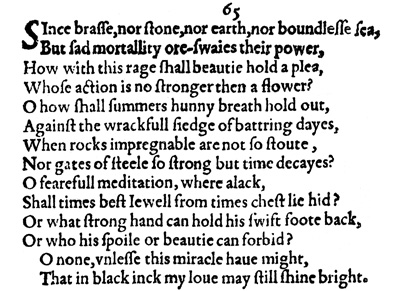
Sonnet 65 – An Introduction


William Shakespeare, the poet who brought definitive merging of Conceptual meaning &diction with a number of 154 sonnets that were authored in two distinct flavors. The essence that the sonnets primarily evince is brilliant with a tinge of logic around.

To comprehend what the sonnets elucidate, the reader needs to understand the personal life of Shakespeare interconnected to two others, namely, the Earl of Southampton & the Dark Lady. Predominantly, the sonnets revolve around these characters. The Earl of Southampton, a man of kindness, is said to be Shakespeare’s best friend and according to Shakespeare what a paradigm of exceptional charm is. The Dark Lady, her maiden name being Mary Fitton, is coy, flirtatious and her Love towards men termed inconsistent. She was Shakespeare’s mistress even before getting sensually attracted to the Earl of Southampton.

The division of the flavor that the sonnets reflect takes a perfect shape when Shakespeare gets dumped by his mistress. The first definite set talks about the matchless inspiration of Shakespeare, the Earl of Southampton and the second set about the humiliation from unattainable love.

In sonnet 65, the conceptual tug of war between time and love is excellently portrayed, bringing decisive content to limelight & getting off the ladder of Elizabethan Exuberance. This is what almost each critic of the century said. The uses of imagery in sonnets are wide, vivid, yet logical, hence divided as abstract and concrete. The abstract imagery is the relationship that runs amongst Shakespeare, Earl and the Dark Lady. Concrete Imagery is the usual representation of nature and entities that form the atmosphere of the verse.

Shakespeare also made clear that the idea of imagery is never confined within the limits of simply witnessing. Feelings, idea, movement also fall under imagery that one can actually feel. Theoretically those are the senses like Tactile, audio, visual, kinesthetic. However, Factuality & conceptuality chiefly account to the formation of imagery.

With a mix of broad use of imagery, cutting the use of mythological figures and tending to a Conceptual domination, Sonnet 65 ultimately pictures Subtle truth.

Friday, November 25, 2011

Edmund Spenser –The Poet’s Poet

Edmund Spenser needs no introduction as a facile poet and takes the sole credit for creating an entirely new version of poetic art. For years, young poets have worshipped Spenser as a source of inspiration further labeling him as “The Poet’s Poet”… Spenser’s gravestone in the Westminster Abbey has a quote written on it which says “The Prince of Poets of All time”… His works are never grounded with artistic imagery; rather did he cast his renowned melodious spell with a balance of rhythm & rhyme…

Dr. Ben Johnson, one of the eminent critics of Spenserian time, rightly called as the skillful representative of poetry, denigrated almost works of every poet. Nevertheless, the surge of popularity that Spenser brought in through his style of authoring rose, thus enabling Dr. Ben Johnson to positively appreciate the entities of Spenserian manner and matter. Surrounded by a lot of critics though, Spenser was always the zenith of renaissance poetry.

Spenser’s poetry reflected a keen sense of Renaissance spirit and platonic idealism. Spenser was no doubt the Conceiver of innovative thoughts. He brought in the idea that Poetry is a sacred form of art and rendering it is true divinity. His verses vindicate poetic beauty more often. Never did he try writing verses of Art, religion & Society. As lovingly called the “English Virgil” Spenser was largely affected by prominent philosophers like Aristotle, Plato, Virgil & Theocritus. This tinge of Platonic idealism sprouted in Spenser with the cult of renaissance. His Spenserian Stanzas were followed by brilliant poets like Byron, Wordsworth, Milton, Keats, Dryden, and Romantics & Pre-Raphaelites.

With a chaste taste in poetic art, Spenser continually themed the aspects of Beauty in nature, art & Human beings. Every single thing around was a manifestation of GOD and deserves to be loved truly. Moreover, those appearances were an embodiment of love and purity. Such is the thought liberated by Spenser. The idea gained large acceptance thus titling him as “The Poet’s Poet”

Edmund Spenser, most superior poet remarked for his stupendous stylistics, lovely verses & musical beauty shall always be remembered for his progressive impact on the sacred skill of poetry.

Wednesday, November 23, 2011

Poetic Style of Spenser


Spenser is undoubtedly the “Poetic son of Chaucer”. As a poet, Spenser always wanted to innovatively expand the language. His works do not follow a strict lingo and he encouraged the use of archaic and rustic expressions. Spenser’s fine style always ranged from housing classicisms to conversions of foreign words. In every poem, Spenser significantly elevated the elegant use of archaic idioms & native expressions thereby making the lines sound elegant and exotic.

Previously, poets considered classicism boring and weakly expressive & never used any of such words in their works. On the other hand Spenser made his peers understand that linguistics positively develops with fine discovery of new words. Spenser at the outset did not follow any sort of dialect either. What makes his verses unsurpassed is that the sincere blend of rustic & archaic idioms, transparent phraseology, quasi-medieval diction, fair amount of classicism and some adaptations from the northern dialect. The light of renaissance shone brightly in works of Spenser, he ardently supported novelty in English language and envisioned it as a benchmark of developmental era.

Spenser’s style of writing included epithets, alliterations and iambic hexameter which add to the rhyme and rhythm of the verse. Epithets that Spenser used decorated the content and never gave any actual meaning. Spenser as a verbal expert can mesmerize readers with sweet musical lines of lyrical intensity. Spenser’s grammar is simpler, lucid and embraced fresh technicalities like the alexandrine or the iambic hexameter. The iambic hexameter could be divided into 12 syllables or six phrases which brought in a beautiful halt at the end of the stanza & sometimes also accounted to summarizing the meaning of the stanza or representing one complete portion of the scene in the stanza.

As an outstanding poet of non-dramatic renaissance, Spenser’s got it all...With opulent musical lines, harmony of rhyme and rhythm & grammatical simplicity with modernization of linguistic entities, Spenser still rules for his uniqueness.

Monday, November 21, 2011

Critical Appreciation of Prothalamion

Prothalamion, the best spousal verses of all time, though less sensible than its sister poetry, Epithalamion; is a lyrical benchmark running softly as musical rhyme. The entire verse is a pure magic with the refrain “Sweet Thames run softly till I end my song” which symbolizes life on earth to be steady in order to be able to listen to the eternal song. The artistic imagery, sweet music and lyrical power make Prothalamion an unparalleled product of non dramatic renaissance. The refrain brings a mode of five stresses which embraces the tonal quality of rivers and water bodies.

Through the verse, Spenser reflects transparency and fine classical imagery. Beyond doubt, Spenser charges the atmosphere with references to two great rivers; namely Thames and Lee. The confluence is described in such a beautiful way that the rivers are symbolized as elements of love. Wholly, the atmosphere of the poem brings in serene bliss, earnestness and joy.

The penning of the verse essentially must have begun from the Latin poems namelyW.Vallan’s “A tale of two swanes” & Leland’s “cygment cantio” as models. However, Spenser brought in conventional imagery such as flowers, birds, rivers and woods. Two swans, represented as the daughters of Somerset, the brides. The swans embody purity, eternal bliss and contentment. With more classical imagery, Spenser adds the fights at the Spanish Armada by the Earl of Essex, Spenser’s birth and livelihood in London. The moon (Cynthia), Venus,Nymphs, Cupid and Twins of Jove, Jupiter and Leda are other classical images which Spenser uses are metaphors. He also talks about the Muse (Goddess of Poetry) here meaning Spenser himself, to author a verse of merit to the Earl of Essex.

Dr. Johnson says that Prothalamion holds autobiographical lines of Spenser which is a conventionality. As a Renaissance poet, Spenser shouldn’t have done that and historical references do not always prove fruitful and enjoyable when it comes to poetry. Moreover, Spenser fails to bring the actual scene of marriage and instead concentrates more on the descriptive verse. Eventually, the content becomes less factual and dreamier with absence of the real brides. Contrarily, Epithalamion revolves around the lovely wedlock of Spenser himself, thus making it more realistic and appealing.

Prothalamion, an epitome of soothing musical verses and a portrayal of elegance is embroidered with bliss and purity. The artistic imagery, sweet music and lyrical power make Prothalamion an unparalleled product of non dramatic renaissance

Saturday, November 19, 2011

Prothalamion – Edmund Spenser

Prothalamion, a spousal verse by Edmund Spenser is one of the loveliest wedding odes. The verse is essentially the wedlock of twin sisters; Lady Catherine and Lady Elizabeth with Henry Gilford and William Peter.

Conversely, on comparison with Epithalamion, the verse is considered less realistic and unappealing. Spenser incorporates classical imagery strongly with a beautiful atmosphere in the poem. The emphasis of renaissance on Prothalamion brings a tinge of mythological figures like Venus, Cynthia and Titan.

Prothalamion:

Stanza 1:

The poet walks along the banks of River Thames to forget the worries of his personal life. He was completely frustrated with the Job at the court and all he wanted is some mental peace. The cool breeze covered the heat of the sun by reflecting a shade of tender warmth. There are flowers everywhere and the birds chirp happily. The poet as a refrain requests the river to flow softly until he ends his song.

Stanza 2:

The poet happens to see a group of nymphs along the banks of the river. Here the poet makes use of first Mythological figure, the nymphs which are supernatural maidens known for their purity. Every nymph looked stunning and had loose strands of hair falling to the shoulders. Nymphs together prepared bouquets of flowers with primroses, white lilies, red roses, tulips, violets and daisies.

Stanza 3:

As the second mystic entity, Spenser introduces the swans. Swans that swam across the river looked holy and whiter than Jupiter who disguised as a swan to win his love, Leda. But, yes, what Spenser says next is that these swans are shinier than Leda herself. The River Thames requests its waters not to dirty the sacred wings of the swan.

Stanza 4:

The nymphs were all dumb struck watching the swans swim across the river. Swans are usually assigned to drawing the chariot of Venus, the goddess of love. The white lilies are matched to the purity or virginity of the nymphs.

Stanza 5:

As the next step, the nymphs prepare poises and a basket of flowers which look like bridal chamber adorned with flowers. The nymphs on excitement of the upcoming wedding throw the flowers over the River Thames and birds. The nymphs also prepare a wedding song. With all the fragrance of flowers, Thames exactly looked like the Peneus, the river of ancient fame flowing along the Tempe and the Thessalian valley.

Stanza 6:

The song of the nymph mesmerizes with an enchanting musical effect. Here Spenser wishes the couple live forever with swans’ contented heart and eternal bliss as these birds are the wonder of heaven. He also prays to Cupid and Venus to bless the couple with love and care lest they be safe from deceit and dislike. With endless affluence and happiness, their kids must be a sign of dignity and a threat to immoral people.

Stanza 7:

The river Lee, with headquarters at Kent, flows with happiness on such an occasion. As the birds flew above the swans, the sight looked like moon (Cynthia) shining above the stars.

Stanza 8:

Once the wedding starts at London, the poet begins to recollect his encounters at the mansion and the building where the wedding occurs.

Stanza 9:

The Earl of Essex lived in the mighty castle which actually was the venue of the wedding. He was so chivalrous that he served as a danger to foreign countries. His brave attack on Spain shot him to fame and entire Spain shook at his very name. Queen Elizabeth was so proud of him and he deserves to be celebrated with a poem.

Stanza 10:

The Earl of Sussex walked towards the river and he looked fresh with his lovely golden hair. He was accompanied by two young men who were brave, handsome and glorious. They resembled the Twins of Jupiter namely, Castor and Pollux. The men held the hands of the brides and their wedlock begun thereby.

With all the necessary ingredients for a successful verse, Prothalamion is embroidered with long lasting style and simplicity.