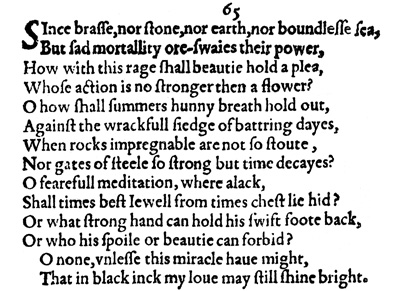
Sonnet 65 by William Shakespeare feasts every reader with
excellent conceptual content which persistently overpowers the visual imagery
in the sonnet. Within the verse, the imageries that are represented take
sensible yet subtle turns to complement each other. The Portrayal of characters
in the Shakespearean sonnets is highly intellectual and rich in linguistic
style.
SONNET:
Since brass, nor stone, nor earth, nor
boundless sea,
But sad mortality o'er-sways their power,
How with this rage shall beauty hold a plea,
Whose action is no stronger than a flower?
O, how shall summer's honey breath hold out
Against the wreckful siege of battering days,
When rocks impregnable are not so stout,
Nor gates of steel so strong, but Time decays?
O fearful meditation! Where, alack,
Shall Time's best jewel from Time's chest lie hid?
Or what strong hand can hold his swift foot back?
Or who his spoil of beauty can forbid?
O, none, unless this miracle have might,
That in black ink my love may still shine bright.
ANALYSIS:
Initially, the
Words that reflect different imageries need to be figured out.
- “Brass”,” Stone “, “boundless sea” – visual imagery ( can be observed)
- “Sad Mortality”, “wreckful siege of battering days”, “Time decays” – Conceptual imagery ( can hardly be visualized)
- “summer's honey breath”—conceptual and can pertain to touch which means one can feel the warm air of Summer
- “Rocks impregnable”, “gates of steel so strong”—literal imagery (which explains a fact)
- “Time's best jewel”, “Time's chest” –metaphorical usage which represents two different meanings.
Basically being a lyrical cry, the sonnet is written to
stress upon the inconsistency of love. The feeling of love is delicate than a
flower and could be subject to destruction by any force. Shakespeare introduces
physical entities like brass, stone and sea which can’t go head to head with
the destructive power of time. After all, it’s time that decides the lifespan
of every single thing on earth.
Something that cleverly accounts to the
comparison of death and time is the metaphorical usage in the words “Time's best jewel”, “Time's
chest” casting magical bliss.
“Time's
best jewel”- the Earl’s love which he personally thinks is a force &
“Time's chest”- death which finally embraces the most beautiful
jewel of love.
Shakespeare skillfully places conceptual, visual and literal
imagery side by side bringing perfect harmony all through the verse.
To finally understand what’s in the sonnet, the natural rush
to appreciate a simple comparison is seriously needed. Let’s begin rephrasing…
None of nature’s
products can withstand the catastrophic power of time, be it brass, stone or
sea, Crushing death is what would be the result.
Love being all the more
delicate, softer than a flower cannot stand before the power of destruction.
The warm summer air again cannot last for long when days and seasons keep
changing.
When strong rocks and gates of steel are shattered how can love hide
itself from the chest of time (death).
Beauty and love can survive only if
there is a miracle turning things topsy turvy. However, feelings can die, not
what Shakespeare writes in black ink.
Truth through his black ink would survive
and create logical impulse to make people understand the fact of life.
Lastly, Shakespeare strongly believes that conceptual writing
produces everlasting masterpieces and brings reasoning to play. Sonnet 65 holds
the credit for being the best conceptual piece of love poetry cutting down on
elaborate Elizabethan style and introducing crisp, interesting content.
-- Sashank Franklin Sargunaraj & Roopa